Chapter 1 ended on two questions about your exchange: how far from entry a perpetual liquidates at your leverage setting, and what fees and funding cost to hold it. Futures basics for a beginner means answering both from one contract's own terms, not from the chart. This chapter ends in a dated fact sheet for one perpetual.
The chart shows price. It does not show what you hold: a contract with no expiry on a coin's price, written by one exchange, so two traders with the same chart and stop can face different liquidation prices and different bills for holding. Read its terms in this order: margin mode, then liquidation, then cost, because the margin mode changes the liquidation figure. For a linear contract on isolated margin, liquidation sits roughly 100% divided by your leverage setting from entry, a little closer after maintenance margin and fees. The limit: fee tiers, funding rates and maintenance tiers change, so date every line when you read it and read it again before relying on it.
| Line | What you write | Test it must pass |
|---|---|---|
| Contract | Exchange, symbol, and linear (margined and settled in a stable quote currency) or inverse. | Is it linear? This manual's sums do not apply to an inverse contract. |
| Margin mode | Isolated (only the margin you assign backs the position) or cross (your wallet does), and any auto-add option. | Does it read isolated, with auto-add off? |
| Liquidation | The order form's estimated liquidation price for a long or a short at your setting, as a percent from entry, and the price that triggers it (mark or last). Read it before you confirm anything. | Is the setting within your charter's ceiling, and did the figure come off the form? |
| Fees | Maker (resting order) and taker (immediate fill) rates for your tier, from the exchange's fee page. | Is the taker rate written down? |
| Funding | The interval (the contract's own) and the current rate, stamped with the time you read it. Positive means longs pay shorts; negative, the reverse. | Do you know whether your side pays or receives? |
| Cost to hold | Fees on both fills plus funding over your planned hold, for the side you would take, as a percent of position value. | Does it say that it assumes the rate stays put and leaves out spread and slippage? |
| Verdict | Keep the contract on your Markets line (with any condition this sheet sets), change it, or drop it, with a sentence of reason. "Unresolved" counts if a term cannot be found, such as a form that shows no estimate before the position is open. | Could someone else see which line decided it? |
Objectives
This step supports one decision: whether the contract on your Markets line is somewhere you will hold a position at all, given where it liquidates and what holding costs. It comes now because the sizing in chapter 3 and every plan after it use these numbers. It uses the Markets line and the leverage ceiling from your charter.
- Say what a perpetual is: a contract on a price, with no coin owned.
- Set the margin mode first, then compare the rule-of-thumb liquidation distance with the order form's estimate.
- Turn a fee rate, a funding rate and an interval into a holding cost for a planned hold.
- Turn that cost into the nearest stop this manual's cost limit allows.
Isolated margin and the cost limit are this manual's choices, not exchange rules or a recommended allocation. Isolated margin does not limit the planned losses of positions that stop out together. The cost limit makes a trade a pass when costs exceed one fifth of its planned loss: a lower bar rejects more trades, and a higher one lets costs use more of the loss budget.
Hypothetical walkthrough: a holding cost that rules out tight stops
Hypothetical walkthrough. Invented prices and an invented outcome, chosen to teach the decision. Not a recorded trade, and not evidence of how often this setup works.
Assume the reader from chapter 1, with a $5,000 account, a 1% planned loss and a 2x ceiling, filling the sheet for a long on one coin from their Markets line.
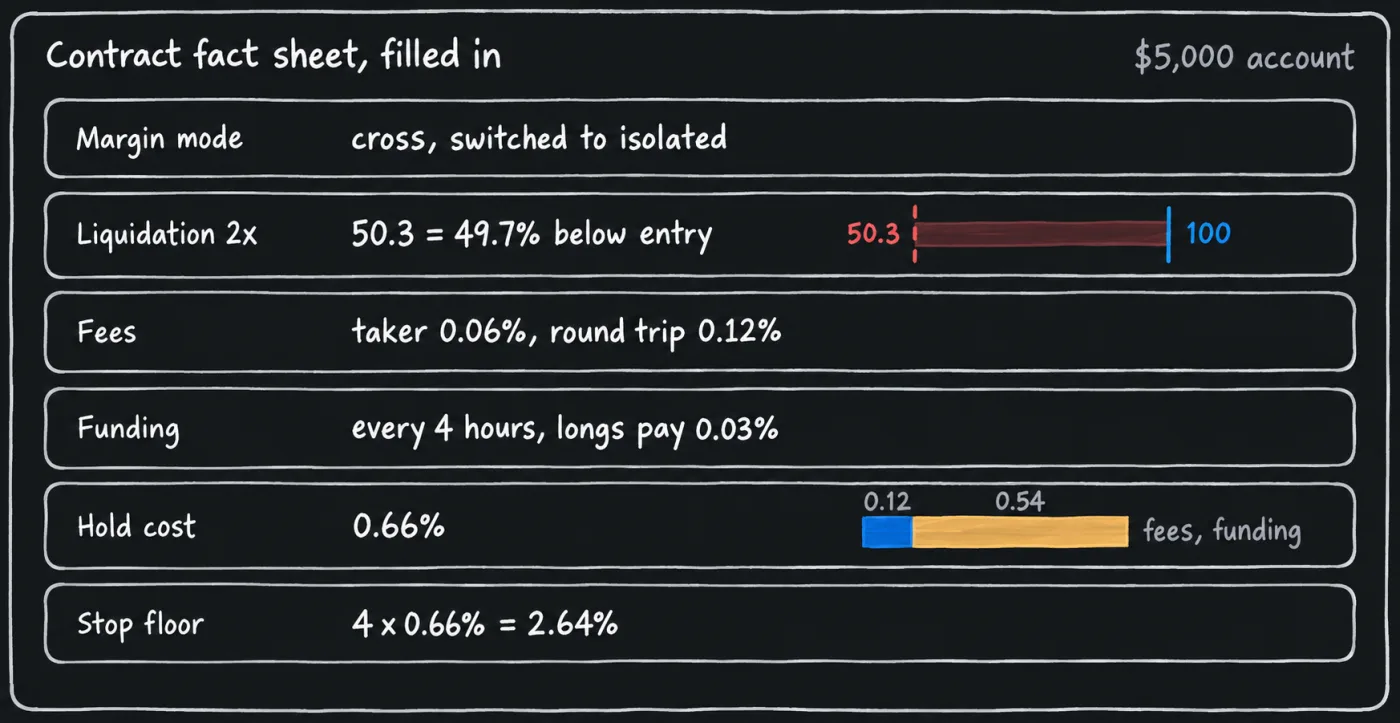
- Margin mode: the account opens in cross. They switch this position to isolated first.
- Liquidation: at 2x, with an assumed entry of 100, the form estimates 50.3, which is 49.7% below entry. The rule of thumb says 50%. They record the form's figure and the price that triggers it.
- Fees: a taker rate of 0.06% of position value, 0.12% for a round trip.
- Funding: every 4 hours, and longs pay 0.03%. Assume the rate stays put. A three-day hold is 18 payments, 0.54% of position value.
- Cost to hold: 0.66% of position value, before spread and slippage.
The planned loss includes costs. With a stop d from entry and costs c, it is d + c, and costs stay within one fifth of it only if d is at least 4c. Here that is 4 x 0.66%, or 2.64% of entry, assuming a constant position value, an unchanged rate and 18 payments; spread and slippage push it wider. Account size does not enter. The stop still goes where the idea is wrong. The sum says only that, on this contract and at the rate on the sheet's date, a stop closer than 2.64% with a three-day hold is a pass. The reader adds the test, a stop at least four times the cost to hold, to the charter's pass rule and recomputes the cost from the sheet each time.
The outcome was chosen to show the cost line limiting plans before any is written.
Reading list
- How perpetual futures work: what you hold, how mark, index and last price differ, and linear and isolated.
- Leverage: the setting against position value over equity, and the rule of thumb of 100% divided by the setting.
- Liquidation price: why the real figure sits closer than the rule of thumb, and why the form's estimate is the one to use.
- Funding rates: who pays whom, how the interval sets the number of payments, and what a stretched rate does not say. The funding scanner lists current rates; the contract page is the manual route.
- Trading costs and liquidity: fees on both fills, spread, slippage and the one-fifth limit.
The first three give the vocabulary and what to read off the order form, and the last two turn a hold into cash. If the numbers rule a contract out, change the Markets line.
This chapter cannot settle what you may lose. Liquidation distance is where the exchange takes over, not a loss budget, and the cost line is what holding charges. Neither says what you lose at the price where your idea is wrong, which comes from your stop and your size. The question to carry forward: with your sheet's costs in the distance, how many units can you hold so that a stop costs only your planned loss? Risk and position sizing turns that into a risk budget sheet.
You should now be able to
- Say what a perpetual is and that holding one does not give you the coin.
- Read the margin mode and the estimated liquidation price on an order form before you confirm anything.
- Turn a fee rate, a funding rate and an interval into a holding cost for a planned hold.
- Work out the stop distance below which costs break the one-fifth limit.
- Produce: your contract fact sheet for one perpetual (margin mode, funding, fees, liquidation distance), dated, using the table at the top of this page.