A sound trading mindset is a habit of deciding before you trade. You choose your exposure: which markets, how much you plan to lose, whether to take part at all. You do not choose the result. This chapter ends with a one-page charter that fixes those choices while no money is on the line.
The moment this is for: a large green candle is printing, you want in, and you cannot say at what price the idea would be wrong. If that answer is not written down, the stop you pick afterwards can end up set by the loss you can stand, not by where the idea fails. A result mixes three things: your decision, the order you send, and what the market did with it. One result cannot separate them. A trade stopped out at its planned price may have been a sound decision, and a trade with no stop that made money may not have been. Ask two questions after every decision. Did you follow the plan you wrote? Is that plan worth following? The first is answered from the page. The second needs a record of many decisions.
The decision cycle behind every page here has seven steps: observe, shortlist, write a conditional plan, name the invalidation (the price at which the idea is wrong), set a risk budget, execute, review. A step with nothing to show for it ends the cycle as a pass. The charter sets what the cycle may work on. It cannot make a plan good, only visible. Treat the first version as a draft: chapter 3 turns its risk ceiling line into a full risk budget, and chapter 10 revises the charter.
| Line | What you write | Test it must pass |
|---|---|---|
| Markets | Contract type, exchange, and which coins are in scope. | Could someone else tell whether a coin is in scope? |
| Timeframes | The candle you decide on, the one you read for the larger trend, and when you look. | Do your looks cover every candle close your plan needs? |
| Risk ceiling | Planned loss per trade and a leverage ceiling, with the planned loss in dollars. | Could you take that loss several times running without changing the plan? |
| Pass rule | Two to four yes/no conditions. Any one means no trade. | Can you answer each in a minute with the chart open? |
The Timeframes test is a scheduling check. A 4-hour candle closes six times a day, so someone who looks twice a day can act on at most two of the six.
Objectives
This step supports one decision: what you are willing to trade at all, and how much you may lose, before any single trade is on the table. It comes first because every later chapter works inside the limits it sets.
- Reconstruct one recent trade from the record you have.
- Name the seven steps of the decision cycle in order.
- Write a pass rule as yes/no tests you can run in a minute.
- Choose markets and timeframes that fit the hours you can actually watch.
- Set a risk ceiling inside this manual's house constraints.
The house constraints are a planned loss of 1 to 2% of the account per trade and a leverage ceiling of 3x. They are this manual's choices, not a recommended allocation. If every stop fills as planned and each planned loss is taken from the balance at the time, ten stop-outs in a row take about 10% off the account at a 1% planned loss and about 18% at 2%. At a 3x setting on isolated margin, liquidation comes after a move of about a third against you, a little less once maintenance margin and fees count. The ceiling applies to both the leverage setting on the order screen and position value divided by account equity. The limit: planned loss is the loss if your stop fills where you set it, and slippage, gaps, fees and funding can make the realised loss larger. Risking less, or not trading, sits inside the constraints.
Hypothetical walkthrough: a charter that turns down an order
Hypothetical walkthrough. Invented prices and an invented outcome, chosen to teach the decision. Not a recorded trade, and not evidence of how often this setup works.
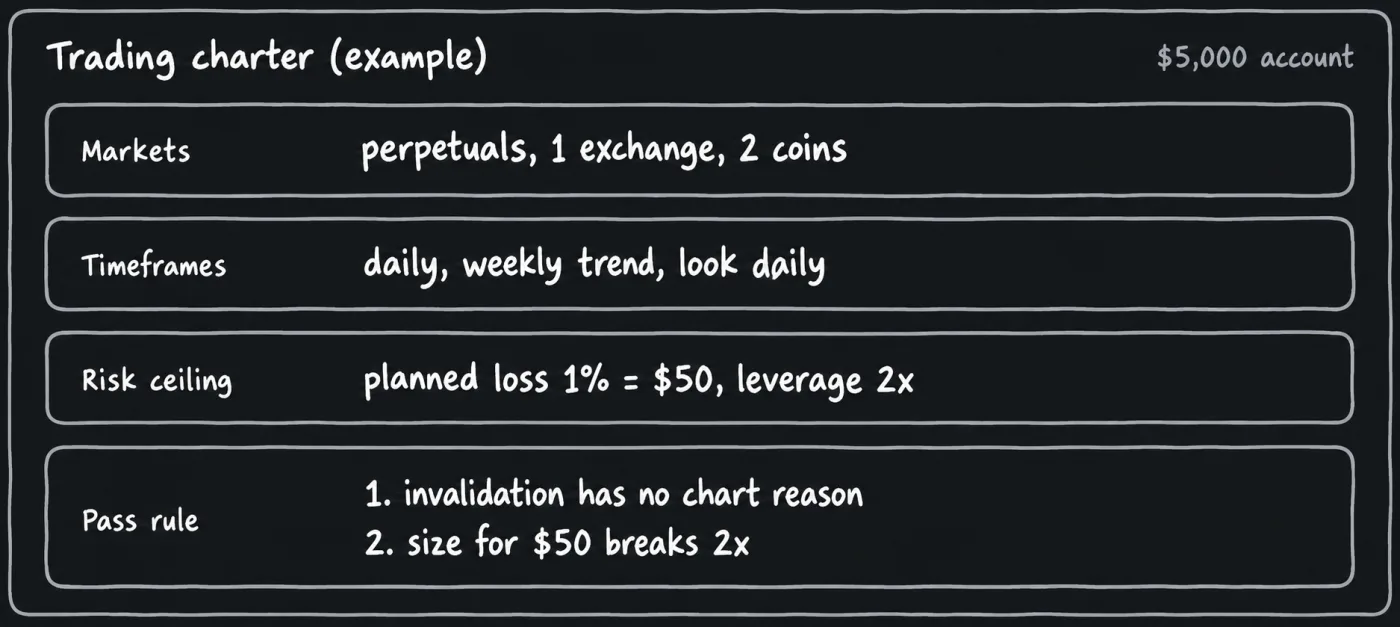
Assume a reader with a day job and a $5,000 account. Their first-draft charter reads:
- Markets: perpetual futures on one exchange, two coins from its highest-volume list. Anything else is a pass before they look.
- Timeframes: decide on the daily candle, read the weekly for the larger trend, look once a day just after the daily close.
- Risk ceiling: a planned loss of 1% per trade, which is $50, and a leverage ceiling of 2x.
- Pass rule: pass if the invalidation price has no reason you can point to on the chart, or if the size that fits $50 breaks the 2x ceiling.
Just after the daily close, one of the two coins prints a large green candle. The reader's idea is that the move continues, and they open the order form. The first pass condition asks for the price at which that idea is wrong. The only number they come up with is 3% below entry. Asked why, the honest answer is that 3% is the distance at which the position they want fits $50. That number was chosen to allow the entry, and there is no level there where the idea fails. The condition is met. They log the date, the coin and "pass: invalidation has no chart reason", and close the form.
It stops at the pass, chosen to show the rule catching a stop picked to fit a size. It supports one judgment: the pass followed the written rule, not that the rule is good.
Reading list
- The decision cycle: the seven steps, what each produces, and why a justified pass is a finished decision.
- Rules checklist: the same steps as one checklist. Check your ceiling line against its risk items.
- Expectancy and drawdown: what the average result per unit of risk measures, and what a run of losses and a fall from a peak do to an account under a fixed planned loss.
Read the decision cycle first, then use its seven steps as questions about one recent trade. For each step, ask what you wrote down before entry, what you decided during the trade, and what you cannot recover. Being unable to recover the reasoning is a finding, not a failure: it makes "nothing written before entry" your first pass condition.
This chapter cannot settle whether your rules are any good. It makes your decisions reviewable and cites no test of any rule set. Chapter 10 covers checking that with a record of many decisions. The question to carry forward: on your chosen exchange, how far from entry does a perpetual position liquidate at your leverage setting, and what do fees and funding cost to hold it? Futures basics has you answer both in a fact sheet for one perpetual on your Markets line. If the answers rule that contract out, change the line.
You should now be able to
- Reconstruct one recent trade step by step and say what was written before entry.
- Name the seven steps of the decision cycle in order.
- Write each pass condition as a yes/no test you can answer with the chart open.
- Turn a planned-loss percentage into a dollar amount for your current balance.
- Say what a few results can and cannot tell you about a set of rules.
- Produce: your one-page trading charter (markets, timeframes, risk ceiling, pass rule), using the table at the top of this page.