Definition
A repeatable trading decision follows seven steps in order: observe, shortlist, write a conditional plan, name the invalidation, set a risk budget, execute, review. Each step has one output you can check, and any step from observe to execute can end the cycle as a pass. This is the decision cycle. It measures and predicts nothing; it makes a decision repeatable and reviewable.
How it works
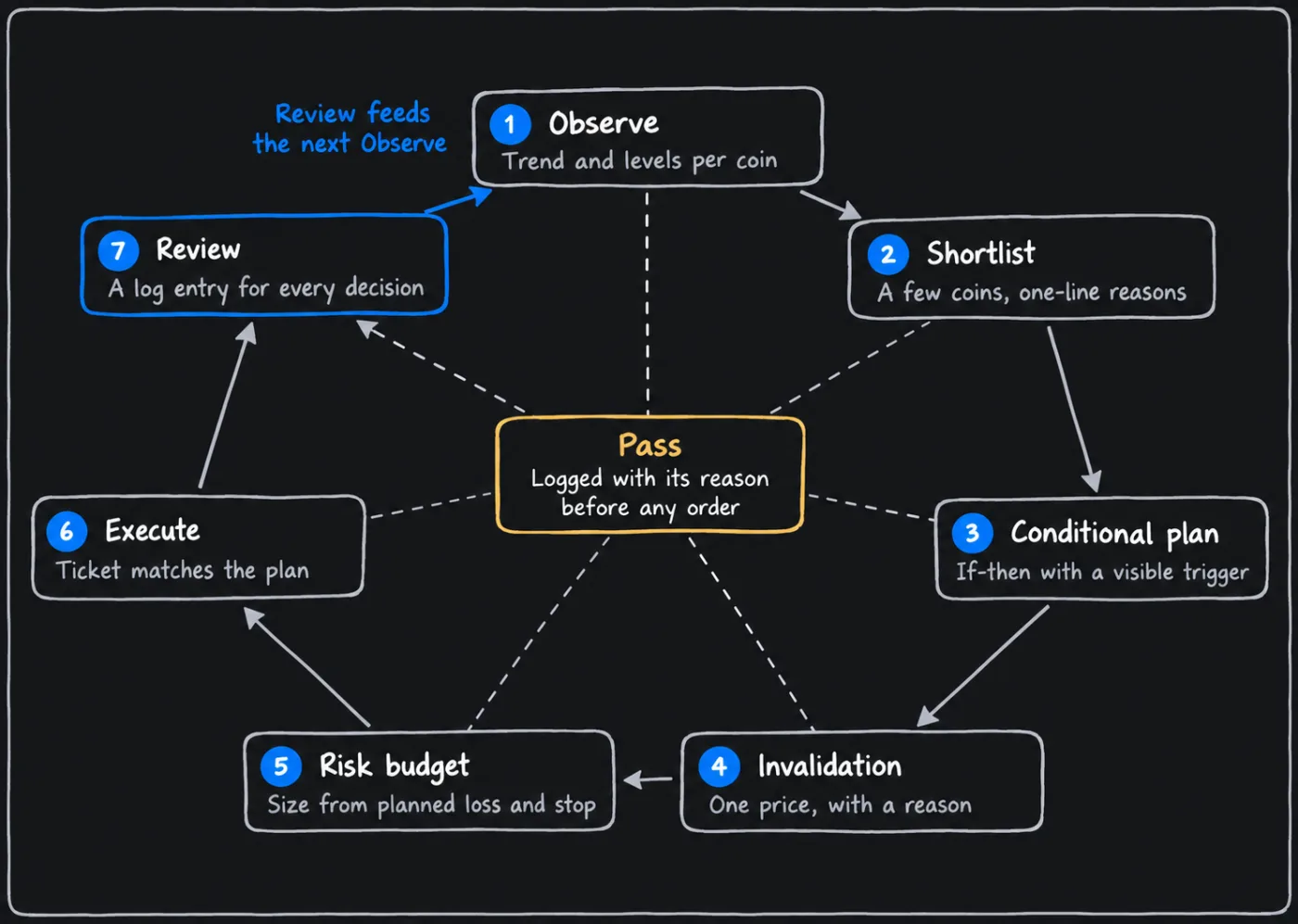
Each step answers one question and leaves one thing on the page. If the thing is missing, the cycle stops there.
| Step | Question | Output you can check | Pass if |
|---|---|---|---|
| 1. Observe | What is each coin in scope doing on your timeframes? | A note per coin: trend and nearby levels | The coin is outside your charter, or you cannot state the trend without guessing |
| 2. Shortlist | Which coins deserve a plan today? | A few coins, each with a one-line reason | None meets the reason you set in advance |
| 3. Conditional plan | If this happens, what do you do? | An if-then sentence with a trigger you can see on the chart | You cannot state the trigger as something visible |
| 4. Invalidation | At what price is the idea wrong? | One price, with a reason you can point to on the chart | You cannot name one, or the only reason is that it makes the size fit |
| 5. Risk budget | How big can the position be? | A size from the planned loss and the distance to the stop order, buffer included | The size capped at your leverage ceiling, or the size the stop allows, is too small to be worth taking; costs exceed one fifth of the planned loss; or the trade would push its group or the total open planned loss over a cap |
| 6. Execute | Does the order match the plan? | A ticket whose entry, stop and size match the plan, with the estimated liquidation price well beyond the stop | The ticket and the plan disagree |
| 7. Review | Did you follow the plan, and is it worth following? | A log entry for every decision, passes included | Never a pass. A missing log entry is the failure |
The invalidation comes before the size because the order decides what the stop means. A stop chosen after the size can end up wherever the loss you can stand puts it. For arithmetic only, assume an entry of 100 and an invalidation at 97, with the stop order at 96 once a buffer is added beyond it (stop-loss placement covers the buffer). The stop is 4% from entry. If the planned loss is 1% of the account, the position is 25% of the account, because 1 divided by 0.04 is 25%. That is the loss if the stop fills at 96. A fast market can fill it worse, and then the realised loss is larger than planned. A stop 1% from entry, by the same arithmetic, calls for a position equal to the whole account. If the size the arithmetic gives is above your leverage ceiling, size down or pass.
The cycle gives two review questions, and they are different. Did you follow the plan you wrote? That is answered from the page. Is the plan worth following? One result does not answer it, and neither do seven completed steps. A plan that followed every step and was stopped out may have been sound. A plan with no stop that made money may not have been. Neither result tells you which. A log of many decisions is the start of an answer, which is what the trading journal and expectancy and drawdown cover.
A pass is a decision made by a rule you wrote before you looked, logged with its reason before any order. Nothing on the shortlist met the reason you set. The invalidation could not be named. The size that fit the ceiling was not worth taking. Log it like a trade. A pass you cannot explain is a skipped step.
Default settings
This page cites no published default for this process, so the table lists the reference values this manual uses. Each is this manual's choice.
| Item | Value | Status and limitation |
|---|---|---|
| Steps and order | Observe, shortlist, plan, invalidation, risk budget, execute, review | This manual's choice. Other orders exist. This one puts the invalidation before the size. |
| Planned loss per trade | 1 to 2% of the account | House constraint. A choice, not a recommended allocation. It is a planned loss, not a cap on the realised loss. Lower is allowed. |
| Leverage ceiling | 3x | House constraint, on both the order-screen setting and position value divided by account equity. At 3x, liquidation sits about a third from entry, a little less after maintenance margin and fees, so the stop has to sit well inside that. A lower setting moves liquidation further from entry, and a lower cap shrinks the largest position. Lower is allowed. |
| What is logged | Every decision, passes included | This manual's choice. Logging only trades hides the decisions not to trade. |
| When the pass reason is written | Before the order | This manual's choice. A reason written after the entry can be bent to fit the result. |
| Variation: shorter cycle | Steps 1 and 2 merged into one scan | A variation. It breaks when the scan stops leaving a written reason for each coin. |
How it is used in this manual's setups
Each setup covers steps 3 to 5 for one pattern: the trigger, the invalidation and the size, and each carries a reason to pass. The ending diagonal breakdown is one example, from the discretionary wave approach. The Chandelier Exit is one way to manage a trade after step 6, as a trailing rule written into the plan before entry.
The chapters follow the cycle. Trading mindset writes the charter that sets what is in scope for step 1. Chapters 5 to 7 cover observing and shortlisting. Chapter 8 builds the plan and the invalidation. Chapters 3 and 9 cover the risk budget and execution, and chapter 10 covers review and revises the charter. The rules checklist lists the same steps as a tick-box.
Common mistakes
- Starting at execute. Price moving feels like a reason. Make the first thing you write the invalidation. If you cannot, pass.
- Writing the stop after entry. Put the invalidation in the plan before the order form is open.
- Inventing an invalidation to fit a size. The price must mark where the idea is wrong, for a reason you can point to on the chart, not the nearest price that makes the arithmetic work.
- Counting a pass as a wasted day. A pass that follows your rule is a finished decision. Log it with its reason.
- Editing the plan after entry. Moving the stop toward profit as the plan's own exit rule says is not an edit. If the idea has changed, close the position and write a new plan.
- Reviewing only the losses. A win that skipped a step needs the same review.
What this cannot tell you
- Whether your plan has an edge. The cycle makes a decision repeatable, not profitable, and this page cites no test of any rule set.
- Which coin to trade or which way price will move.
- That the loss will match the plan. Slippage, gaps, fees and funding can make the realised loss larger than the planned loss.
- Whether an invalidation is well chosen. The cycle asks for a price and a reason. It cannot judge the reason.
Questions
How do you make a repeatable trading decision?
Use the same seven steps in the same order every time, and write one checkable output at each. If a step has no output, stop and log a pass. Then review whether you followed the plan and whether the plan is worth following.
Is not trading a decision?
Yes, when it follows a rule you wrote before you looked and goes in the log with its reason. A pass with no reason is a skipped step, not a decision.
Does following the decision cycle mean a trade will win?
No. The cycle makes the decision repeatable and reviewable. It says nothing about where price goes next, and a plan that followed every step can still lose up to its planned loss, or more in a fast market.