What it is and when it applies
An ending diagonal is a rising wedge that forms as an uptrend runs low on buyers. Price keeps making higher highs, but each push up is shorter than the last, and each dip falls back into ground the trend already covered. Draw one line across the highs and another across the lows, and the two lines converge. This setup shorts the break below the lower line.
In Elliott Wave terms the wedge has five legs. Waves 1, 3 and 5 touch the upper line; waves 2 and 4 touch the lower one. The pattern only appears at the end of a move: wave 5 of an impulse, or wave C of an A-B-C correction. It never forms as a third wave, so a wedge in the middle of a move is a different pattern or a wrong count. After the break, the pattern points to a fast move back toward the level where the wedge began. Price may never get there.
It fits a coin that has trended up for some time and now grinds higher with less force. It does not fit a vertical, parabolic run, a coin that has gone nowhere for weeks, or a thin market where one large order can push price through your lines. The volatility scanner helps you spot these. Wave counts are working guesses. Two careful traders can label the same chart differently, so plan for the count being wrong.
Before you enter
Pick the stop first. It goes outside the pattern: above the wave 5 high, or above the failed bounce high if you enter after the break. If price climbs back over that level, the wedge has not finished and the count is wrong, so the reason for the short is gone. A stop inside the wedge sits where ordinary swings will reach it.
Size the position from the distance between your entry and stop. This manual's house constraints are a planned loss of 1-2% of the account per trade and 3x maximum leverage, both choices and not a recommended allocation; less is allowed. Divide the cash amount you are willing to lose by the stop distance as a fraction of price; the result is the position's value. On a 10,000 account at 1%, the planned loss is 100. Slippage, a gap, fees or funding can make the realised loss larger. If the stop is 4% above your entry, the position can be worth 2,500, because 4% of 2,500 is 100. The position sizing page covers the arithmetic.
Leverage only supplies the margin for that position. It does not change the loss at the stop. At 3x, a move of roughly a third against you forces the position to close, and fees and maintenance margin make that distance a little smaller. A short against a strong uptrend can face a sharp spike, so the stop must sit well inside that distance.
Use a stop-market order, or a stop-limit with its limit price above the trigger, because a short's stop has to buy. A stop-limit with its limit equal to the trigger can sit unfilled while price jumps past it. Write down the entry, stop, targets and reward to risk before placing any order. If one is missing, skip the trade.
Conditions
- The wedge sits where a fifth wave or a C wave could end, after a clear move up. A wedge mid-trend does not qualify.
- Both lines slope up and converge. The lower line rises faster.
- Wave 4 drops into the price range of wave 1. In an ordinary impulse it would stay above the top of wave 1.
- The legs shrink: wave 1 is the longest, wave 3 shorter, waves 4 and 5 small. Wave 3 is still not the shortest of waves 1, 3 and 5.
- Each leg splits into three smaller swings. Legs that clearly split into five point to a plain impulse, so skip it. Exact labels on every small swing are not required.
- The lines run through candle bodies, not the furthest wicks (see trendlines and channels). A wick over the upper line is not a close beyond it, so by this setup's rule it does not break the pattern. It can be a failed push that traps late buyers. If the only line that fits cuts through many candles or needs an impossible count, redraw it.
- Momentum fades into the top. RSI peaks lower on wave 5 than on wave 3 (bearish divergence), and a lower-timeframe MACD histogram shrinks on the final push. Each is one reason among several, not a trigger.
- The top of the wedge meets real resistance, such as a prior high or an old support level that now caps price.
- The higher timeframe agrees. When two timeframes disagree on the count, the higher one wins.
Entry
There are three entries, ordered from most confirmation to least.
- Short the failed retest. Wait for a candle to close below the lower line, then for price to bounce toward the line or back into the wedge. Short when the bounce stalls and turns down; one rejection candle on a low timeframe often shows the turn. This is the retest entry.
- Short the break. Sell as a candle closes below the lower line. The entry price is better, but a retest into the wedge can reach a tight stop.
- Short a double top. If price makes a second, failed attempt at the wave 3 high, shorting there gets you in before the wedge breaks. That failed push is a truncated fifth wave: wave 5 stops short of the wave 3 high. Its stop goes just above the double-top high. A push through that high is the ordinary wave 5 still running, which ends this entry, not the setup.
Shorting at the upper line before a break is the weakest choice, because the wedge can extend through one more leg. Each added step of confirmation gives up part of the drop and lowers the risk. A large reward, a small risk and full confirmation pull against each other, so decide which two you want before entering.
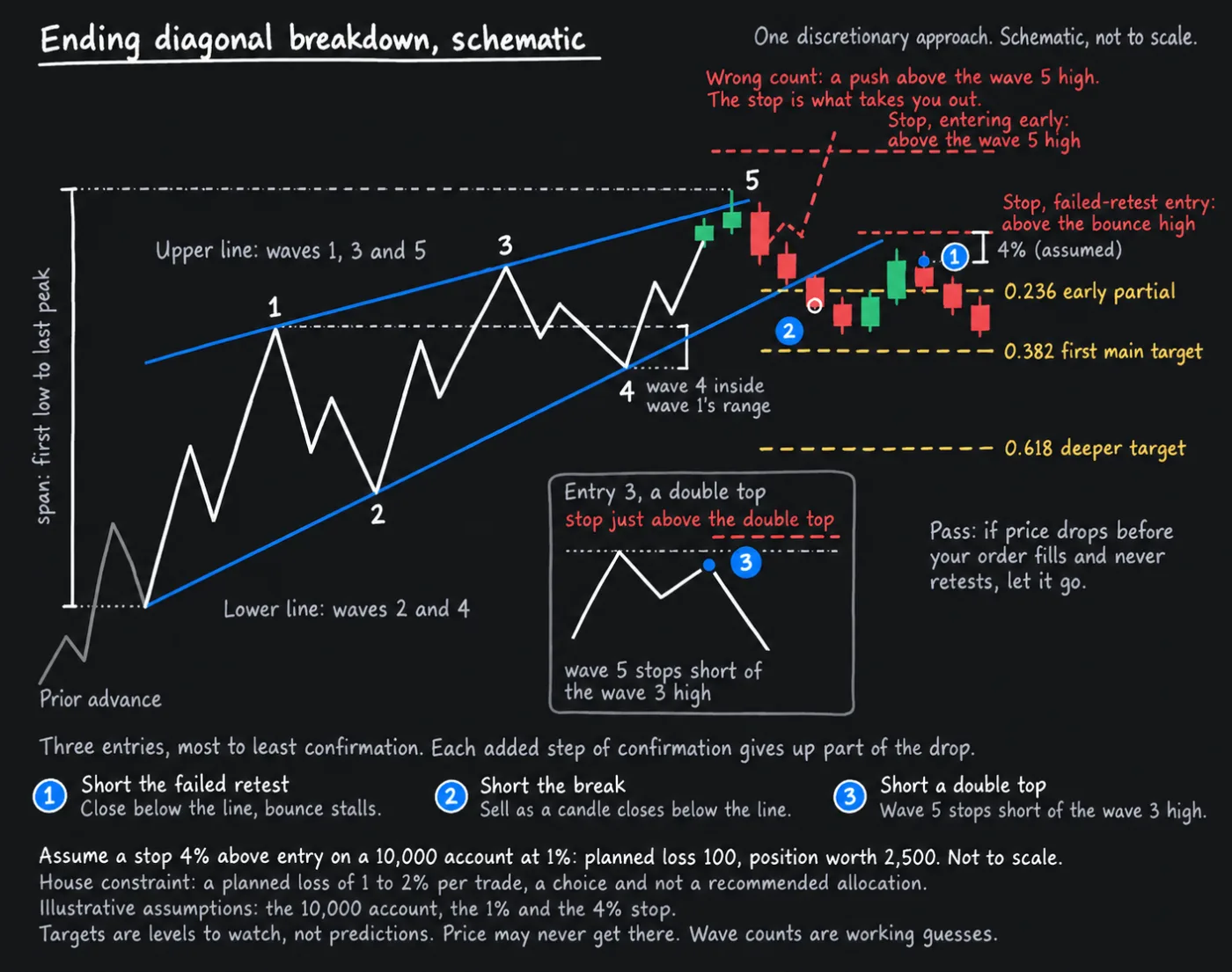
If price drops before your order fills and never retests, let it go. Chasing after the first leg of the drop leaves the stop far away and shrinks the reward to risk. Wait for the next bounce or skip the trade. If price rises above the wave 5 high before your order fills, cancel it.
Exits
Stop. Keep a real stop order above the wave 5 high or the bounce high until the trade moves your way. Judge failure on a candle close rather than a wick, but use that to decide the idea is dead, not to pull the order.
Taking profit. Anchor a Fibonacci retracement where wave 1 began and stretch it to the wave 5 peak, so it spans all five legs. Measuring only the last leg gives weak levels. Look for 0.236 as an early partial, 0.382 as the first main target and 0.618 as the deeper one, and give a level more weight when old support lines up with it. The 1.618 level of a trend-based Fibonacci extension marks a deeper level worth watching, not one to build the plan on. If you cannot watch the trade, take profit before the nearest support.
Moving the stop. Once the first target fills, move the stop down to your entry or just above the latest lower high. You can trail the rest with a Chandelier Exit. Choose a method and use it long enough to judge it before switching.
Ending early. Close the trade if price reclaims the lower line and holds above it, if a spike above the top makes another count more likely, or if price moves sideways for longer than the wedge took to form.
Common pitfalls
- Selling the first close below the line, then watching the bounce reach your stop. Wait for the retest to fail, or place the stop where a normal retest cannot reach it.
- Calling every rising wedge an ending diagonal. Check that it sits at the end of a move and that each leg splits into three swings.
- Confusing it with a leading diagonal. A wedge at the start of a move, in wave 1 or wave A, usually resolves the other way, so check where it sits in the trend.
- Forgetting the second count. A spike to a new high after the break can make the drop wave A of a correction, with a B wave that tops the wedge. The stop above the wave 5 high is what takes you out in that case.
- Adding to the short as price climbs. Size once, from the stop, and take the loss if the stop triggers.
- Trading it on a parabolic coin. Skip any coin in a vertical run; the stop would need to be so wide that the position becomes tiny.
Questions
Is an ending diagonal the same as a rising wedge?
The shape is the same. The Elliott label adds two checks: the wedge sits in a wave 5 or wave C position, and each leg splits into three swings. A rising wedge in the middle of a trend fails both.
Which timeframe should I use?
Use the timeframe where the wedge is easy to see and the count is clean, usually one hour or higher. If a lower timeframe disagrees with a higher one, go with the higher one.