Definition
To calculate position size in crypto, divide the cash you plan to lose by the distance from entry to stop. For arithmetic only, if that cash is 100 and the stop sits 2 below a 50 entry, the position is 50 units. The stop sets the size, never the reverse.
This manual uses fixed fractional sizing, where the cash is a set share of the account. Use it to decide how big a trade is, and whether the size the stop allows is worth taking.
How it works
The chart comes first. It gives an entry and the price where the idea is wrong, as stop-loss placement explains. Sizing turns that distance into a quantity, and the leverage setting is chosen after the size, not before it.
This manual's house constraints are a planned loss of 1 to 2% of the account per trade and a leverage ceiling of 3x. They are choices, not a recommended allocation, and a lower figure, or no position, is always allowed. The limitation: a percentage cannot tell you whether the stop is right, and several open positions in the same direction add up (see portfolio risk).
The sums below assume a linear contract with profit and loss in the quote currency, such as a USDT-margined perpetual. Inverse contracts and contract multipliers need converting first. Use current account equity, not last week's balance. There are two ways to run the sum, and they agree:
- By units: units = cash at stake / (entry minus stop). For a short, use stop minus entry.
- By value: position value = cash at stake / stop distance as a fraction of entry.
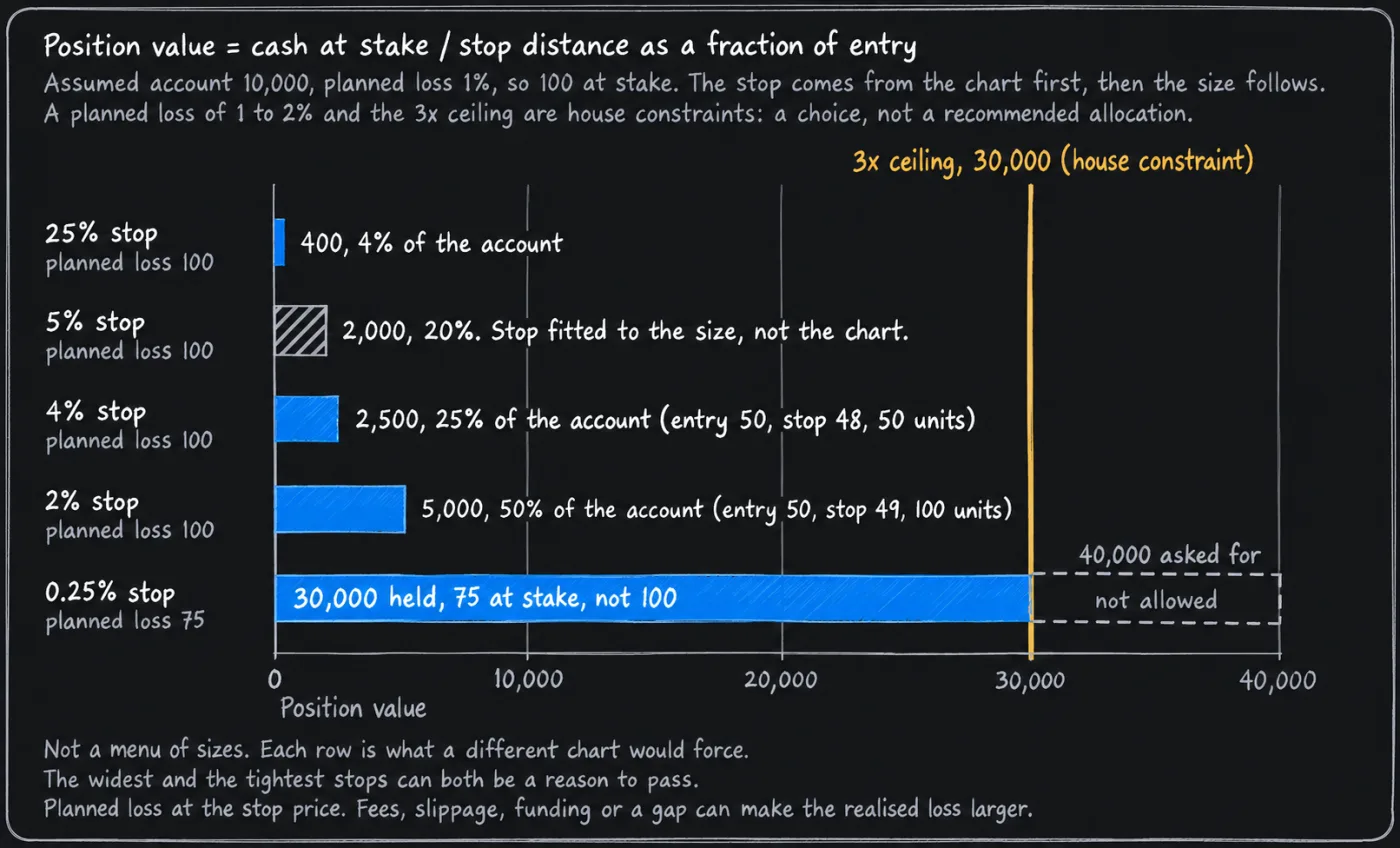
For arithmetic only, assume a 10,000 account and a planned loss of 1%, so 100 is at stake. You buy at 50 with the stop at 48, which is 2 below entry and 4% of it. By units, 100 / 2 is 50 units. By value, 100 / 0.04 is 2,500, and 50 units at 50 each is the same 2,500.
Now suppose the chart puts the stop at 49, 2% away. The cash at stake is still 100, so the position doubles to 5,000, or 100 units. A closer stop allows a bigger position and a wider one a smaller position, with the same planned loss. That makes a closer stop tempting. A stop earns its place by marking where the idea fails, not by flattering the size.
The 3x check
Divide position value by account balance. The result has to be 3 or less. Here 5,000 / 10,000 is 0.5, nowhere near the cap. The cap bites only on very tight stops. A stop 0.25% away would call for a 40,000 position, four times the account. At 3x the most you can hold is 30,000, which puts 75 at stake instead of 100. Take the smaller size, or pass.
Leverage is not the size
Margin is position value divided by the leverage setting. The 5,000 position locks 5,000 at 1x and about 1,667 at 3x, and the planned loss is 100 either way. The leverage page covers what the setting does change.
When the stop makes the position tiny
Assume the idea is wrong 25% below entry. Then 100 / 0.25 is a position of 400, 4% of the account. If 400 is below the exchange's minimum order, or too small to justify the work of managing it, the trade is not worth taking now. Pulling the stop in to 5% would give a 2,000 position, and it would put the stop where ordinary swings test it. Pass instead.
Costs come on top
The sum gives the planned loss if the stop fills at its price. Fees on entry and exit, slippage on a stop-market fill, and funding you pay on perpetual futures all add to it, and a gap through the stop adds more. To allow for the ordinary part, add an assumed cost per unit to the stop distance. Assume fees and slippage together come to 0.3 per unit in the first example. Then units = 100 / (2 + 0.3), about 43.5, and rounding down to a whole unit gives 43, worth 2,150. The planned loss, costs included, is 43 x 2.3 = 98.9. A gap can still push the realised loss past it.
Then run the checks in order: position value over account balance is 0.215, well under 3; the margin is that value divided by the leverage setting; and the liquidation price on the order ticket sits far beyond the stop. Exchanges quote perpetual contracts in different units, so convert the position value into the unit the order form uses, and check which one you typed.
Default settings
| Setting | Value | When it applies |
|---|---|---|
| Planned loss per trade (house constraint) | 1 to 2% of the account, as a fixed fraction | Every trade here. A lower figure suits a new process or an account you cannot afford to see fall. |
| Leverage ceiling (house constraint) | 3x | A ceiling, not a target. Position value never exceeds three times the account balance. |
| Variation: fixed cash amount | The same cash at stake on every trade | Simple to apply, but the share of the account drifts as the balance changes. Recheck it against 1 to 2%. |
| Variation: volatility-based sizing | Size falls as ATR rises | For traders who set the stop as a multiple of ATR. A jumpier coin gets a wider stop and a smaller position. |
Kelly and fixed-ratio schemes also exist. They need an estimate of edge or a record of past gains, and this page cites no test showing an edge for any setup, so the manual does not use them.
How it is used in this manual's setups
Every setup sizes the same way. Find the stop on the chart, calculate the size from that stop and the planned loss, then check the 3x cap and the liquidation price. The risk limits page states the rules together.
- Ending diagonal breakdown. The stop goes above the wave 5 high, and the short is sized from the distance to it. The setup's first example uses the same account, loss and stop distance as this page, so the two agree.
- Chandelier Exit trend ride. The first stop comes from chart structure and sizes the trade at entry. The trailing line moves later, and the position size does not change with it.
Common mistakes
- Choosing the size first and fitting the stop to it. Place the stop where the chart shows the idea has failed, then calculate. If the size is too small to bother with, skip the trade.
- Treating leverage as the size. Divide position value by account balance and keep the result at 3 or below, whatever the setting says.
- Changing size after a loss or a hot streak. Keep the planned loss the same after a loss. After a strong run, keep it the same or lower it, never higher. Adding size to win a loss back can end an account, and a good run is not evidence that you can carry more.
- Counting each position alone. Three longs in coins that tend to move together can act like one large trade, not three small ones.
- Trading on after a heavy day. When the day's losses are already large, stop. A second trade taken to recover them is sized by the wish to recover, not by the stop.
What this cannot tell you
The sum gives the planned loss if the stop fills at its price. It does not cap the realised loss, which a gap, slippage, fees or funding can push higher. It cannot tell you the stop is in the right place: a correct calculation on a stop that sits where ordinary swings reach gives you a precisely sized loss. And it says nothing about whether the trade has an edge. Sizing controls what a loss costs, not how often one comes.
Questions
How much should I risk per trade in crypto?
This manual's house constraint is a planned loss of 1 to 2% of the account on any one trade, with leverage at or below 3x. It is a choice, and no page can name the right figure for your account. Less than 1% is allowed.
Does higher leverage let me take a bigger position?
It lets you hold the same position with less margin. The position still comes from the planned loss and the stop distance, capped at 3x. Leverage changes how much cash is locked and how close liquidation sits.
What if the stop is so wide the position is tiny?
Then the trade pays little for the stop it needs, and passing is a sound result. Narrowing the stop to get more size puts it where normal swings will hit it.