Definition
Leverage lets you hold a position worth more than the cash you put up. It is position value divided by margin, the collateral the exchange locks while the position is open. At 3x, 1,000 of margin holds a 3,000 position.
Leverage changes how much cash is locked and how close the exchange's liquidation sits. The planned loss at a stop comes from position size and stop distance, not from the leverage setting. Use it to decide how much margin a position already sized from its stop should lock, and whether to borrow at all.
How it works
Margin, not size
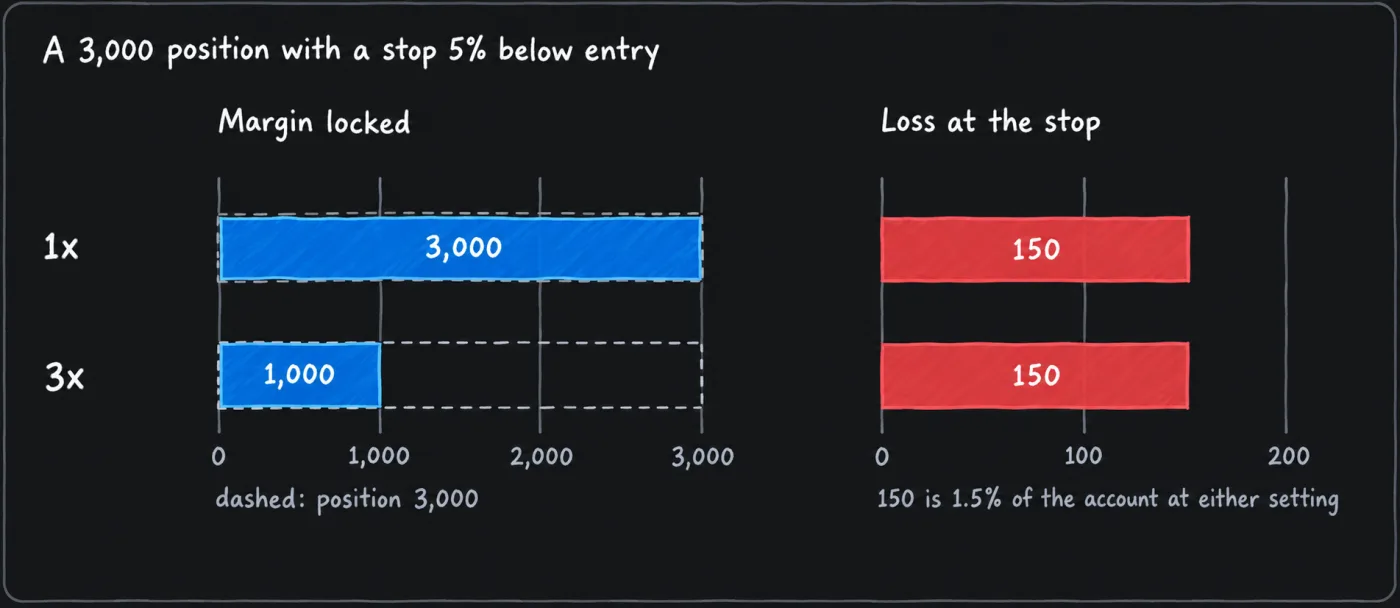
Assume a 10,000 account and a 3,000 position with a stop 5% below entry. Hitting the stop costs 150, which is 1.5% of the account. At 1x the position locks 3,000 of margin and at 3x it locks 1,000. The planned loss is 150 either way. A gap or slippage could make the realised loss larger, but the leverage setting is not what does it, as long as the stop fills before liquidation.
Leverage makes a loss bigger only when it is used to hold a bigger position. A bigger position loses more for each point price moves against it. So the order of work is stop, then size from the stop, then leverage last. Position sizing covers the sum.
Two leverage numbers
The setting on the order screen divides position value by the margin assigned to the position. A second figure, position value divided by account balance, says how large the position is next to everything you own. A 3,000 position on a 10,000 account is 0.3 on that second figure, whatever the setting says. Balance here means account equity, and with several positions open you add their values before dividing. This manual's ceiling, a house constraint described below, applies to both.
How far liquidation sits
For margin assigned to one position, the exchange liquidates after a move against you of about 100% divided by the leverage setting. That is about 66% at 1.5x, 50% at 2x and 33% at 3x. The real price is a little closer to entry, and the liquidation price page has the formula.
The distance shrinks quickly as the setting rises: at 10x it is about 10%, a third of what 3x leaves. If you cannot estimate the liquidation distance before you place the order, use 1x.
Costs track position value
Fees are charged on the full position value, not on the margin. On perpetual futures, funding is paid or received on the full value at set intervals. A bigger position costs more even when its margin is small. The funding scanner lists current funding rates, and the exchange's contract page shows the same figure for one coin.
Isolated and cross margin
Isolated margin limits what the position can lose to the margin assigned to it. Cross margin lets the whole account balance back the position, so liquidation sits farther away and one losing trade can draw on money you never meant to commit. Check the margin mode before you open the trade.
Default settings
This manual's ceiling is a house constraint, a choice rather than an exchange rule or a recommended allocation. Its limitation: at 3x, liquidation sits about a third from entry, which protects you only when the stop is a small fraction of that. Using less leverage, or taking no position, is always allowed.
| Setting | Value | When it applies |
|---|---|---|
| Leverage ceiling (house constraint) | 3x | Every trade here. Both the order-screen setting and position value divided by account balance stay at 3 or below. |
| Planned loss per trade (house constraint) | 1 to 2% of the account | Set from the stop distance before choosing leverage. |
| Variation: no leverage | 1x | A new trader, until every stop is taken the moment it is hit. It is still a futures contract, with funding, and not ownership of the coin. |
| Margin mode (this manual's choice) | Isolated | Limits each position's loss to its assigned margin. |
| Variation: cross margin | Whole balance as margin | A trader managing several positions together who watches total exposure. |
Start at 1x, and keep every stop honoured there before borrowing at all. A sizing check works at any setting: if a single losing position would finish the account, the position was too large, whatever number sits on the order screen.
How it is used in this manual's setups
Leverage is never the reason a setup works. Each setup defines its stop, sizes the position from it, then checks the ceiling and the liquidation price. The risk limits page lists the rules in one place.
- Ending diagonal breakdown. The stop above the wave 5 high has to sit well inside the distance to liquidation, which at 3x is roughly a third of the entry price.
- Chandelier Exit trend ride. The trailing line can sit far from price on a volatile coin, so keep the setting low enough that liquidation stays well beyond it.
Common mistakes
- Using leverage to size up. Size from the stop and the planned loss, then check the ceiling. Leverage should only decide how much margin is locked.
- A leveraged position with no stop. Place a real stop order with every leveraged trade, so liquidation is never the plan.
- Raising leverage after a loss. Keep the same limits. Adding size to win a loss back is how one bad trade becomes a lost account.
- Cross margin by accident. Read the margin mode on the order screen before you confirm.
- Treating 3x as a target. It is a ceiling. With a planned loss of 1 to 2%, any stop more than 2% from entry gives a position smaller than the account, which 1x can carry on its own.
- Leverage on a coin in a vertical run. One candle can cover the whole distance to liquidation. Skip the coin, or use 1x with a small position.
What this cannot tell you
A leverage figure cannot tell you how much you will lose. That depends on position size and stop distance, and on how the stop fills. The rule of 100% divided by the leverage setting cannot give your real liquidation price, which depends on the exchange's maintenance margin, fees and margin mode, so read it off the order ticket. And a 3x ceiling does not make a trade safe: a stop that fills badly in a fast market can still cost more than planned.
Questions
What leverage should a beginner use in crypto?
None at first. Trade at 1x until you take every stop the moment it is hit. After that, stay at or below this manual's 3x ceiling.
Does 3x leverage mean three times the risk?
Not if the position is sized from the stop. Position size and stop distance set the planned loss. Leverage changes how much margin is locked and how close liquidation sits to entry.
Why not use the higher limits the exchange offers?
The room before liquidation shrinks as the setting rises, and a volatile coin can cover a short distance in one candle. At 3x that room is about a third of the entry price. Compare it with your actual stop, and keep the stop well inside it.