Definition
The liquidation price is the price at which the exchange force-closes your leveraged position, because the margin left can no longer cover your loss plus the minimum margin the exchange requires. You lose up to the whole margin assigned to the position, and on cross margin possibly more of the account.
It is the exchange's exit, not yours, and it costs more than a stop. Use it to decide whether a position already sized from its stop leaves enough room between the stop and the point where the exchange takes over.
How it works
The rough estimate
Liquidation sits about 100% divided by the leverage setting away from entry. At 2x that is about a 50% move against you, and at 3x about 33%. This manual caps leverage at 3x, so the estimate never comes in much closer than a third.
Why the real price is closer
The exchange does not wait for margin to hit zero. Every position must keep a maintenance margin, a small share of its value set by the exchange, and the position is closed when the remaining margin falls to that level.
Under simple assumptions (a linear contract margined in the quote currency, such as a USDT-margined perpetual, isolated margin, one position, no fees or funding, and maintenance margin at a rate m of position value at the liquidation price) the price works out as:
For arithmetic only, assume m is 0.5%. A long entered at 100 at 3x has a plain estimate of 66.7. With maintenance margin it is 66.67 / 0.995, about 67.0. A short at 100 at 3x comes out at 133.33 / 1.005, about 132.7, a rise of 32.7% where the plain estimate says 33.3%.
Real exchanges differ. Each publishes its own formula, its maintenance tiers (the rate rises with position size) and its fee treatment. Use the formula to understand the mechanism. The estimated liquidation price on the order ticket, read before you confirm, is the figure to use, and it moves as price, funding and margin change.
Mark price
Most perpetual futures exchanges trigger liquidation from the mark price, which is derived from an index of spot prices, rather than the last traded price. One wick on a thin order book is less likely to liquidate you that way. A real move across the market still will. Check which price your exchange uses.
What moves it
- Farther from entry: adding margin, or closing part of the position while leaving its margin in place.
- Closer to entry: fees, funding payments you pay on perpetual futures, and on cross margin, losses on your other open positions.
On isolated margin only the margin assigned to the position backs it. On cross margin the whole balance does, so liquidation sits farther away and one bad trade can drain the account.
Liquidation is not a stop
A stop is a loss you planned, placed where the idea is wrong. Liquidation can take the whole margin behind the trade, often adds a liquidation fee, and can close at a worse price than the one displayed. Some exchanges close positions in steps and keep an insurance fund to cover shortfalls. A stop placed beyond the liquidation price is not a stop at all, because the exchange closes the trade first.
A check to run on every sized position
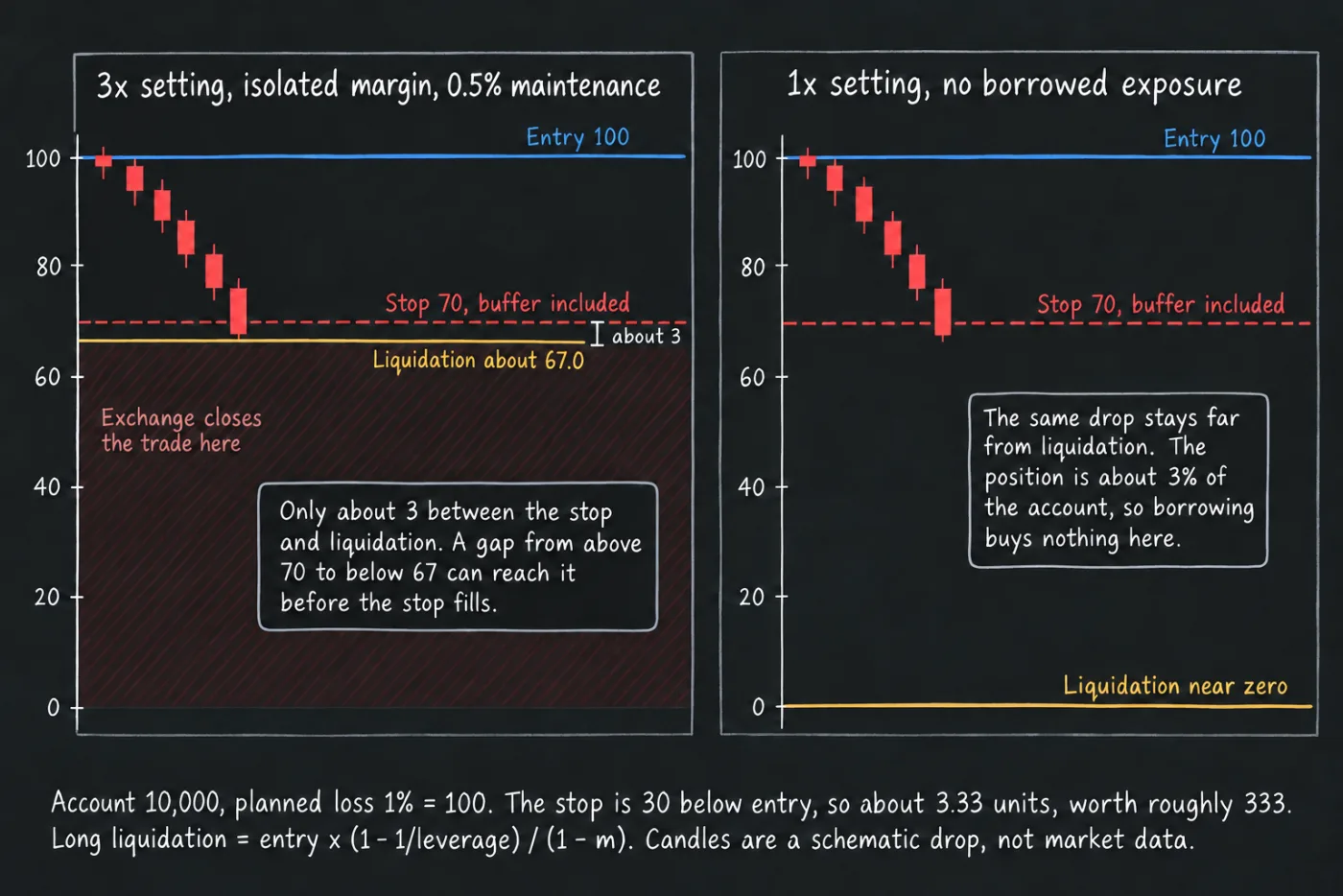
Assume a 10,000 account and a long at 100 whose stop, buffer included, sits at 70. Take a planned loss of 1%, inside this manual's house constraint of 1 to 2% of the account per trade (a choice, not a recommended allocation). The cash at stake is 100. The stop is 30 away, so the position holds 100 / 30, about 3.3 units, worth roughly 333.
At a 3x setting the liquidation price is about 67.0. The stop at 70 sits only 3 above it. A gap that carries price from above 70 to below 67 before the stop fills, or a stop that triggers on the last price while the mark price is already lower, can let the exchange close the trade first. At 1x a long's liquidation price is near zero. The position is only about 3% of the account, so borrowing buys nothing here.
The fix is on the margin side: lower the leverage setting, so more margin backs the position, until liquidation is far beyond the stop. If the stop triggers on the last price and liquidation on the mark price, allow for the gap between them. Moving the stop to open up room puts it where the idea is no longer tested.
Default settings
These are rough distances to liquidation, before maintenance margin and fees. The 3x row is this manual's house constraint, a choice rather than a recommended allocation.
| Leverage setting | Rough distance to liquidation | Notes |
|---|---|---|
| 3x (house ceiling) | About 33%, a little less after maintenance margin | The ceiling in this manual. |
| Variation: 2x | About 50% | More room for a volatile coin or a wide stop. |
| Variation: 1x | A long needs price near zero; a short needs price to roughly double | No borrowed exposure. |
| Above the ceiling: 5x | About 20% | For contrast only. Not used here. |
| Above the ceiling: 10x | About 10% | For contrast only. Not used here. |
The 0.5% maintenance rate in the example is an assumption. The real rate depends on the exchange, the coin and the position size.
How it is used in this manual's setups
Every setup places its stop first, sizes the trade from it, then reads the liquidation price on the order ticket and confirms it sits far beyond the stop. The leverage page covers the ceiling, and stop-loss placement covers where the stop goes.
- Ending diagonal breakdown. At 3x, a rise of about a third liquidates the short. The stop above the wave 5 high has to sit well before that, with room for slippage in a spike.
- Chandelier Exit trend ride. The trailing line can sit far from price on a volatile coin. Keep the setting low enough that liquidation stays well beyond it.
A fast spike is the case this room is for. A stop that is skipped in a fast move leaves the position facing the full distance to liquidation.
Common mistakes
- A stop beyond liquidation. Read the liquidation price on the order ticket after sizing, and keep the stop comfortably before it.
- Trusting the rule of thumb over the exchange. Use 100% divided by leverage as a rough check, then read the ticket.
- Cross margin by surprise. Confirm the margin mode before entry so one losing trade cannot draw on the whole balance.
- Topping up margin to save a losing trade. Extra margin moves liquidation. It does not change the level where the idea failed, so take the stop.
- Forgetting holding costs. Fees and any funding you pay move liquidation closer over a long hold, so recheck the ticket.
What this cannot tell you
The formulas here cannot give your exchange's liquidation price. Tiers, maintenance amounts, fees and margin mode all change it, and the order ticket estimate is the one to use. They also cannot tell you that a stop will fill before liquidation: a stop-market can fill past its trigger in a fast market, and nothing on this page measures how far past. The liquidation price says where the exchange closes the trade, not how likely price is to get there.
Questions
How is liquidation price calculated?
For one isolated position with no fees, a long liquidates near entry x (1 minus 1/leverage) / (1 minus m), where m is the maintenance margin rate. A short uses entry x (1 plus 1/leverage) / (1 plus m). Each exchange's own formula and tiers set the exact figure.
What is the difference between a stop loss and the liquidation price?
You choose the stop at the price where the idea is wrong, and hitting it costs the planned loss if the stop fills at its price. The exchange sets the liquidation price, and reaching it can cost the whole margin backing the position.
Can a wick liquidate me?
Most exchanges trigger liquidation on the mark price, which is built from an index of spot prices, so one wick on a thin order book counts for less. A sharp move across the market still can, and some contracts trigger on the last price, so check which one yours uses.