Definition
Place a stop loss just beyond the price that proves your trade idea wrong, with a buffer so ordinary noise does not reach it. A stop loss is a standing order that triggers at a price you chose in advance and closes the trade. Its job here is to mark where the idea fails, not the loss you can stand.
Use it to decide where the stop goes, and whether there is a trade at all.
How it works
Start from the level the trade depends on
Every trade rests on a level. Find it, then put the stop beyond it.
- Long off a breakout: below the old resistance that price just cleared. If a candle closes back under it, the breakout failed.
- Long off support: below that support.
- Short off a rejection or a fifth-wave top: above the high. A close above it means the top is not in.
A line on a chart is not yet a trade. The stop makes it one by naming the price where you are wrong. A stop inside the pattern, or inside a channel where price is still trading, sits where ordinary swings reach it and gets hit while the idea is intact. Before any order, write down the entry, the stop, the target and what you will do if the stop is hit. If you cannot name the stop, there is no trade.
Give it room for noise
Price rarely turns at the exact tick of a level. This manual uses a buffer measured in ATR, which gives a jumpy coin more room than a calm one.
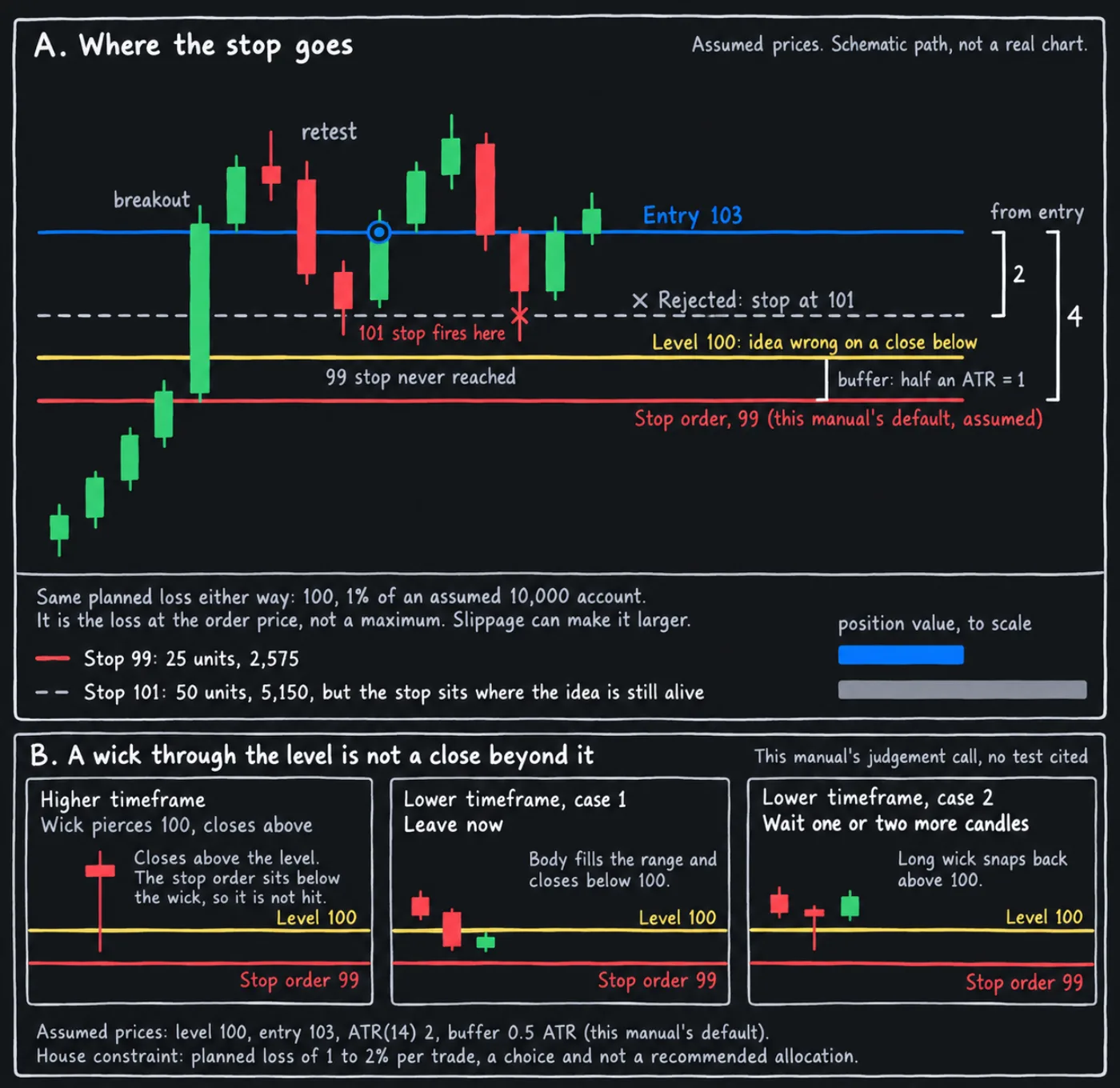
Assume a breakout above resistance at 100, a retest, and an entry at 103. The idea is wrong if a candle closes back below 100. Assume ATR(14) is 2 and a buffer of half an ATR, so the order goes at 99, 4 from entry. Take a 10,000 account and a planned loss of 1%, inside this manual's house constraint of 1 to 2% per trade (a choice, not a recommended allocation). The cash at stake is 100, which buys 25 units, a position worth 2,575. Position sizing has the full calculation, including the 3x leverage ceiling, another house constraint.
A stop at 101 looks more efficient. It is 2 from entry and holds 50 units, worth 5,150. But 101 sits above the level itself, where a retest of the broken level can trade while the idea is still intact, so the bigger size was bought by putting the stop where the idea is still alive. The sum uses the order price, buffer included, not the level. A wide stop means a small position.
Level, close and order
Three things work together, and whichever fires first ends the trade.
- The level is where the idea fails.
- The close rule says the idea has failed when a candle closes beyond the level on the timeframe the setup is read on. A wick alone does not count.
- The order sits beyond the level plus the buffer and triggers on price. It is the backstop for a fast move.
If a candle closes through the level before the order triggers, the exit is yours to make by hand. If price runs to the order without a close, the order ends the trade. A close rule is never a reason to cancel the order, and it needs you at the screen, so a trade you cannot watch relies on the order alone. Place it where you accept being wrong.
One discretionary check is this manual's own judgement call, not a published rule, and this page cites no test of it. When a wick pierces the level on the higher timeframe, look at the 1-minute or 5-minute chart. A candle whose body fills most of its range and closes through the level is a reason to leave now. A long wick that snaps back is a reason to wait one or two more candles.
Choose an order that fills
A long's stop is a sell order and a short's stop is a buy order. A stop-market fills at the next available price once triggered, which is why this manual defaults to it. In a fast move or a thin order book that price can be worse than the trigger. The gap is slippage, and it is why the realised loss can exceed the planned loss. If the form offers reduce-only or close-position, use it, so the stop can only close the trade.
A stop-limit adds a second price. For a long, put the limit below the trigger, and for a short, above it. That improves the chance of a fill without guaranteeing one. With the limit equal to the trigger, the order can sit unfilled while price runs past, and a stop that does not fill protects nothing. Some exchanges let you choose the trigger price: last, mark or index.
Default settings
An ATR-only stop of 1.5 to 3 times ATR(14) from entry is commonly cited, and this page names no single source for it. A fixed percentage from entry is simple but ignores structure and volatility, so it is a weaker choice.
| Method | Where the stop goes | When traders use it |
|---|---|---|
| Structure stop plus ATR buffer (this manual's default) | Beyond the level the trade depends on, plus a fraction of ATR(14). The examples here assume 0.5 | Every setup here. A wider buffer tolerates larger swings and shrinks the position, and a tighter one does the reverse. |
| Variation: wider buffer | One ATR(14) or more beyond the level | Coins and charts where wicks routinely run past levels. It costs size. |
| Variation: ATR-only stop | 1.5 to 3 times ATR(14) from entry | Rule-based traders. It ignores structure, so check that the stop still sits beyond a real level. |
How it is used in this manual's setups
Every setup places its first stop from structure, sizes the trade from it and keeps a real order on the exchange. The risk limits page lists the rules together.
- Ending diagonal breakdown. For an early short, the stop goes above the wave 5 high. After a failed bounce, it goes above that bounce's high. Use a stop-market, or a stop-limit with its limit above the trigger.
- Chandelier Exit trend ride. The first stop comes from structure. Once the Chandelier Exit line moves past it in your favour, the line becomes the stop, and the same lower-timeframe check applies.
On a leveraged position the stop has to sit well before the liquidation price. If it comes anywhere near, lower the leverage setting so more margin backs the position, and leave the stop where it is.
Common mistakes
- Stops inside the pattern. Put the stop beyond the level the idea depends on, where ordinary swings are less likely to reach it.
- Mental stops. Place a real order when you enter. If the plan needs a judgement call you cannot make, skip the trade.
- Moving the stop out, or adding to a loser. A stop may move toward profit, to entry once the first target fills or behind a trailing line. It never moves away from price. Accept the loss when it is hit, because price recovering afterwards says nothing about the decision.
- Choosing the distance to fit a size. Set the stop from the chart first, then size from it.
- Holding past the stop and hoping. If you broke the rule and price drifts back to entry, exit there. The lesson is that the stop was ignored, not that holding worked.
What this cannot tell you
A stop at the level where the idea is wrong cannot tell you the idea is right: price can reverse after a well-placed stop is hit, and that does not make the stop wrong. It also means the order can fill on a wick while a close-based reading of the idea would have held. It cannot fix the exit price, because a stop-market fills at the next available price and a fast or thin market can make the realised loss larger than planned. And it cannot say how much buffer a coin needs. A buffer fitted to last month's wicks can be too small for the next move.
Questions
Should a stop loss trigger on a wick or a close?
The order triggers on price, so leave enough buffer for ordinary wicks to miss it. Judge whether the idea has failed on a candle close, with the lower-timeframe check above as the one exception.
How far away should my stop be?
Beyond the level the trade depends on, plus a small buffer for noise. Then shrink the position to fit that distance.
Is a stop-market or stop-limit order better?
A stop-market is built to fill at whatever price is available, at the cost of slippage. A stop-limit fills only at its limit or better, so it can miss.