Definition
Laddering entries means splitting one entry across several limit orders at different prices, with one stop and one planned loss for the whole set. Sized correctly, if every rung fills and the stop fills at its price, the modelled loss, cost allowance included, is at or just under the planned loss.
It answers two problems. The best entry is often a zone, not one price. And a large order can walk the book, so slicing it into resting orders can cut slippage on a large order, at the price of fill uncertainty, as trading costs and liquidity shows. A ladder does not make the idea right. Use it to decide whether to split this entry, and how many units each rung gets.
How it works
Size the whole ladder from its average entry
Fix the stop first. It goes beyond the level where the idea is wrong, below every rung of a long and above every rung of a short, as stop-loss placement explains. Then the sum from position sizing applies to the average entry, because the planned loss if every rung fills is the units times the distance from each fill to the stop, plus costs:
total units = planned loss / (weighted average entry - stop + cost per unit)
Round each rung down to the exchange's quantity step. For a short, use stop minus average entry.
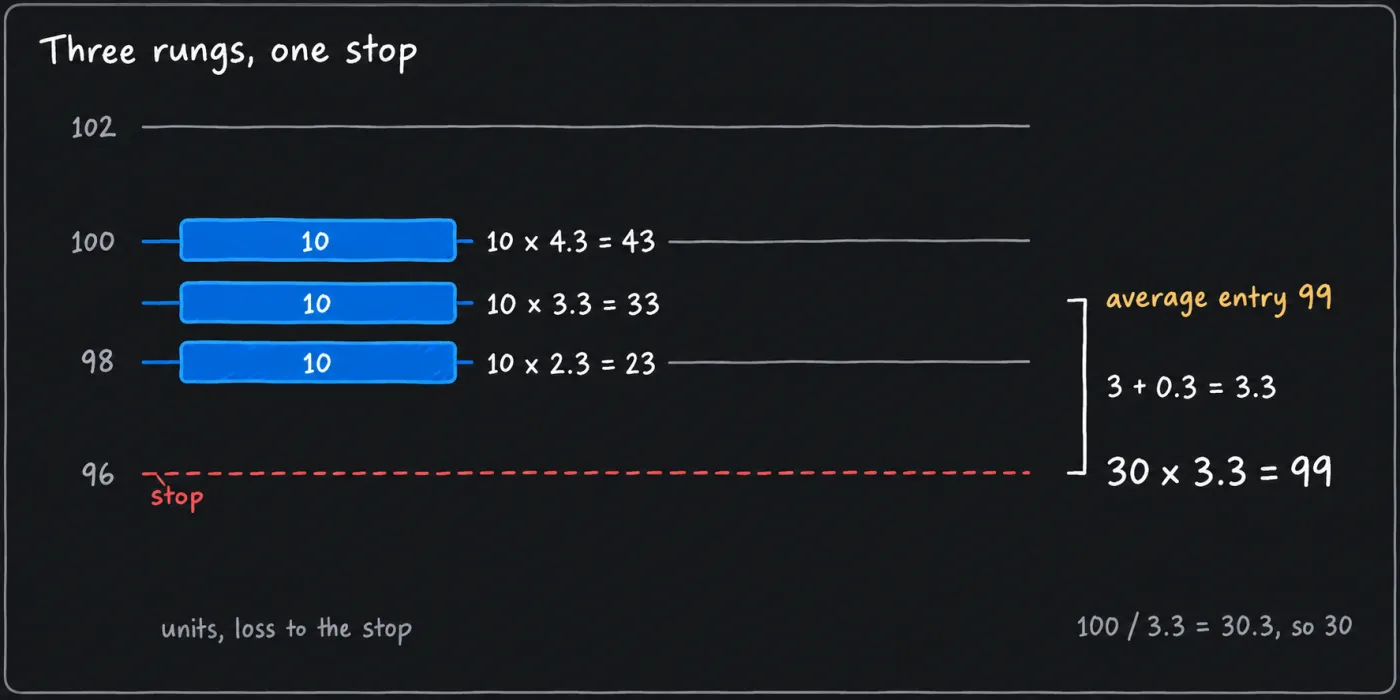
For arithmetic only, assume a 10,000 account and a planned loss of 100, which is 1%, inside this manual's house constraint of 1 to 2% of the account. Assume a long with a stop at 96, three rungs at 100, 99 and 98 with equal units, and costs of 0.3 per unit across both fills. The average entry is 99, so units = 100 / (3 + 0.3) = 30.3, rounded down to 30, which is 10 per rung. Check by rung: 10 x 4.3 = 43, 10 x 3.3 = 33 and 10 x 2.3 = 23, and the sum is 99. Position value if all fill is 2,970, 0.30 of the account, well under the 3x ceiling, which is also a house constraint. A single entry at 100 would hold 23 units, since 100 / 4.3 is 23.3. The ladder holds more only because three rungs have filled and the average entry sits closer to the stop.
Unequal splits use the same sum. Weight the average entry by the units at each price, then check that the sum of units x (rung distance + cost) over the rungs is at or under the budget.
What happens when only some rungs fill
For a long dip ladder, the planned loss builds from the top rung down. A short mirrors it.
| Rungs filled | Units | Average entry | Planned loss if stopped at 96 |
|---|---|---|---|
| 100 | 10 | 100 | 43 |
| 100 and 99 | 20 | 99.5 | 76 |
| 100, 99 and 98 | 30 | 99 | 99 |
A fall to the stop passes every rung on the way, so a stop-out usually comes with every rung filled and the full planned loss taken. A rise before the lower rungs fill leaves a smaller position than you planned.
R is computed on the plan: net result divided by the planned loss of the whole ladder, 99 here, the figure written before the first order. Partial fills, exits and a tightened stop do not change it. Stopped out with only the first rung filled, the result is -43, which is -0.43R. If that rung instead reaches 108, it nets 10 x (8 - 0.3) = 77, which is +0.78R and 0.77% of the account. Count a plan whose rungs never fill as a plan with no result, not a trade.
Three habits keep a partly filled ladder safe. Size the stop to the filled quantity and resize it as each rung fills, reduce-only, or use a close-position stop where the form offers one (order types covers both). Cancel the unfilled rungs when the plan ends, whether the stop, the target or the invalidation ends it, because a rung that fills after the stop opens a position you did not plan. And check the leverage ceiling and the liquidation price for the full-fill size, not the first rung (liquidation price has the check).
The trap: rungs added after the plan
For arithmetic only, assume price falls through all three rungs to 97, with the stop still at 96. An extra 20 units there looks cheap, since each adds only 1.3 of planned loss per unit, 1 of stop distance and 0.3 of costs. But the total is now 50 units at an average of 98.2, and the planned loss is 50 x (98.2 - 96 + 0.3) = 125, 25% above the budget of 100. Move the stop down to 94 to make room and it is 50 x 4.5 = 225, 2.25% of the account, over the house constraint. An added rung is averaging down with no plan, bought on a trade that has already moved against you. If the idea has changed, close and write a new plan, as the decision cycle says. If it has not, the ladder already holds the planned exposure.
Default settings
This page cites no published default for laddering, so the table lists the reference values this manual uses.
| Item | Value | Status and limitation |
|---|---|---|
| Total planned loss | One figure for the whole ladder, 1 to 2% of the account | House constraint, a choice and not a recommended allocation. It is not per rung, and lower is allowed. |
| Rungs | Three in the examples, at real levels inside the zone | Illustrative assumption. More rungs mean smaller pieces, and each must meet the exchange minimum. |
| Split | Equal units in the examples | Illustrative assumption. Any split works with the same sum. |
| Stop | One stop, fixed before the first order, beyond every rung | This manual's choice. It is never moved to make room for another rung. |
| Caps | The full-ladder planned loss counts against the group cap and the 4% total from the first order | This manual's choice. Every rung can fill, so the unfilled ones count. |
| Ceiling | 3x on the full-fill position value | House constraint. A ladder that breaks it means fewer units, or a pass. |
| R | Net result over the full-ladder planned loss written before the first order | This manual's choice. It keeps cumulative R in step with cash, so the pause trigger and expectancy read the same on partial fills. |
| Orders and fees | Limit orders for rungs, reduce-only stop; log every fill's fee | Limit rungs are convention; the reduce-only stop-market and logging every fee are this manual's choices. A limit may not fill, and the flat 0.3 is an assumption. |
How it is used in this manual's setups
A ladder suits an entry into a retracement zone, where price may take several levels to turn. The wave 1 dip buy enters on a pullback, so it is the planned home for it, and that page sets the zone and the stop. A plan with a single trigger and no zone gives a ladder little to do. The rules checklist still applies: one stop, one size, one plan written before the first order.
Common mistakes
- Sizing each rung as its own trade. With the stop at 96, three rungs each sized for a planned loss of 100 hold 23, 30 and 43 units, and a full fill carries 296.8, nearly three times the plan.
- Checking the ceiling and liquidation on the first rung only. Check the full-fill position.
- Adding rungs or moving the stop after the plan. The total planned loss stops being the number you chose.
- Leaving rungs on the book after the trade ends. A late fill opens a new position.
- Rounding up. Round each rung down, so the full-fill loss stays at or under the plan.
What this cannot tell you
- Whether price returns to any rung. It may fill none, or fall through all of them to the stop. A falling price fills every rung, so a ladder holds its largest size when price is moving against the idea.
- That a ladder beats one entry. Against putting everything in at the top rung, it gets a better average price if price dips and a smaller position if it does not. This page cites no test of which pays more.
- The loss in a gap. A gap can skip rungs and fill the stop below its price, so the realised loss can exceed the planned loss.
- How many rungs and what spacing suit a coin. The count and spacing are plan choices, not facts about the market.
Questions
How do you size a ladder of limit orders?
Fix the stop, then divide the planned loss by the weighted average entry minus the stop plus the cost per unit, and round down. Check the sum rung by rung.
Is laddering the same as averaging down?
The orders look alike. The difference is the plan. A ladder is written before the first fill, with one stop and one total planned loss. Averaging down adds after the trade has moved against you, and the total keeps growing.
What if only some of the rungs fill?
Treat the filled units as the trade. Size the stop to them, measure R against the whole ladder's planned loss, and cancel the rest when the plan ends.