Definition
Volume is the amount traded in a period: the bar under each candle, counted in coins, in the quote currency such as USDT, or in contracts, as one exchange or data feed reports it. It shows how much trading took place, not who won it, and not whether positions are being opened or closed.
Use it to decide whether a move traded more than usual, whether a coin is active enough to trade, and whether a turnover condition in your plan has been met.
How it works
What the bar counts
Every trade has a buyer and a seller, so a volume bar is not buying pressure or selling pressure. Many charts colour the bar by the candle's direction, comparing close with open on some platforms and with the previous close on others. A green bar says the candle closed up, not that buyers outnumbered sellers. Some exchanges publish a split of taker buys and taker sells, which shows who crossed the spread, still not who was right.
Check the unit. A bar of 1,000 can mean 1,000 coins, 1,000 contracts or 1,000 dollars of turnover, and the same coin can show different units on different platforms.
Reported volume can be inflated
Wash trading is a party trading with itself to inflate the numbers. It has been reported at some venues, and this page cites no measurement of how much, where, or when. Reported volume is a claim by the exchange. Prefer the venue you trade on, and be careful with a small coin whose volume jumps on a single exchange. Order book depth beside the volume shows what you could trade, not whether the volume is real.
Spot and perpetual volume are different markets
Spot volume and perpetual volume come from separate order books. A chart of a perpetual shows that contract's volume on that exchange, not the coin's volume across the market. A perpetual's volume counts position size traded, in contracts, coins or quote turnover as the feed reports it. Margin lets that exceed the cash behind it, and it includes liquidation orders the exchange fills on the order book. An aggregate across exchanges is another figure again. Read the volume of the contract you will trade. Perpetual futures covers the contract.
Volume is not open interest
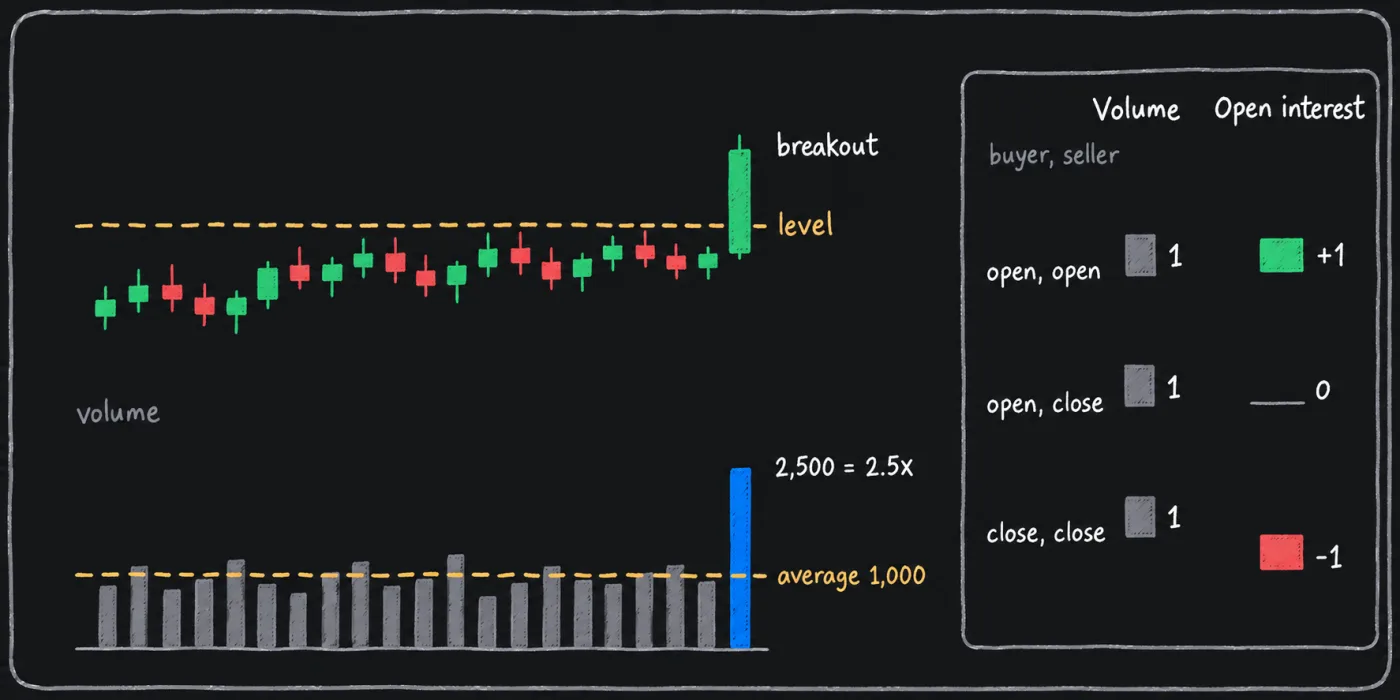
Open interest is the total size of contracts open at one moment, not yet closed, in the unit the exchange reports. Volume is how much traded during the period. For arithmetic only, assume one contract changes hands in each case below.
| Buyer | Seller | Volume | Open interest |
|---|---|---|---|
| Opens a long | Opens a short | 1 | up 1 |
| Opens a long | Closes a long | 1 | unchanged |
| Closes a short | Closes a long | 1 | down 1 |
High volume with flat open interest can mean positions changed hands. With rising open interest, more positions opened than closed. Volume alone cannot tell you which happened.
Reading a bar against its own history
A bar means little alone. Compare it with the same instrument on the same exchange over a recent window. Assume the average over the 20 closed candles before the breakout is 1,000 units and the breakout candle shows 2,500, which is 2.5 times the average. Compare finished bars only: a candle still printing understates its final volume. Many platforms offer a moving average of volume to draw that line. The window and the multiple are choices, and this page names neither as a standard.
What volume can and cannot confirm on a breakout
A breakout is a close beyond a level or line, as breakouts and retests covers. The level or line supplies the price boundary, and volume adds a second, separate condition. Volume can tell you the close came with more reported trading than usual. It cannot tell you the move will hold.
A common belief is that a breakout on heavy volume is more trustworthy than one on thin volume, because more orders took part. That gets one thing right: more trading means more orders were filled at those prices. It breaks in two places. Heavy trading at a level can be both sides fighting, with price absorbed and turned back, and reported volume can be inflated. This page cites no test of the belief either way.
Make it a condition you write: "the breakout candle closes beyond the band with volume above N times its 20-candle average", with N your own number. If the condition is not met, the plan passes or waits. The condition checks reported turnover. It does not predict direction.
Volume and liquidity
Volume shows what traded, not what is resting in the book now. A coin with large daily volume can still have a thin book at the moment you want to trade. Compare your order size with depth near the price, as trading costs and liquidity explains.
Default settings
This page cites no published default for reading volume, so the table lists common conventions. Each is a choice for your plan, and none is this manual's rule.
| Item | Convention | Status and limitation |
|---|---|---|
| Volume bars | As reported by the exchange or feed for the contract you trade | Defined by the source. It can be inflated, and spot and perpetual are separate. |
| Unit | Coins, quote currency or contracts, as your platform sets it | Check it. A number is not comparable across units. |
| Comparison window | Volume against the moving average of the previous closed candles, such as 20 | Assumed example. A shorter window reacts faster and is noisier. |
| Breakout condition | Volume above a multiple of that average, chosen by you | Your choice. This page names no multiple and cites no test of any. |
| Open interest | A separate series, not volume | Defined. Read it where the exchange publishes it. |
How it is used in this manual's setups
Volume is a turnover check, not a trigger. Where a setup's trigger is a close beyond a level, a volume condition is one more line you can write into the plan, and a missing one is a legitimate reason to pass. The volume scanner ranks coins by the change in a 24-hour volume figure against an earlier reading, summed across exchanges rather than the contract's own. The contract page or your chart is the manual route, and either shows only the venue it covers. Volatility covers the other quantity such lists rank by.
Common mistakes
- Reading bar colour as buying or selling. Each trade has two sides. A green bar says the candle closed up.
- Trusting one exchange's volume on a small coin. Check depth and the venue before treating a spike as real.
- Comparing volume across coins, units or markets. Compare a bar with its own history on one contract.
- Treating a volume spike as a signal. A spike says activity, not direction. Take the trigger from the plan.
- Mixing volume with open interest. Volume counts trades. Open interest counts positions still open.
- Judging liquidity by volume alone. Compare your order size with the book near the price.
What this cannot tell you
- Who is winning. Every unit has a buyer and a seller, so total volume cannot say which side was more eager. A taker split shows who crossed the spread, not who was right.
- Whether a breakout will hold. Volume can show the close came with heavy reported trading. It cannot show what the next candle does.
- Whether the volume is real. An exchange's figure can include wash trading, and a chart cannot separate it out.
- Whether positions are opening or closing. Open interest shows the net change in open contracts, and openings and closings in the same period can cancel. It does not give direction.
- What is resting in the book. Volume shows what traded, which is why depth sits beside it.
Questions
How do I read volume in crypto?
Compare each bar with its own recent average on the contract you trade. A bar well above average means more trading than usual. It does not say who won or what comes next.
Does high volume confirm a breakout?
It shows the close came with more reported trading than usual, and no more. Heavy volume can mark a move that holds or one that reverses, and this page cites no test either way.
Is volume the same as open interest?
No. Volume counts what traded in the period. Open interest counts contracts still open. A trade where one side opens a position and the other closes one leaves open interest unchanged and still counts as volume.